
One letter at a time · Original
Poople Guide: Word Ladder Rules and Routes
Every path ends at POOP.
EDITOR'S TAKE
The fixed finish turns a word ladder into a little route-planning problem. Every move feels useful when the path starts to open.
Daily · Word game

 Contexto
THE ORIGINAL DAILY GAME
Follow meaning until the word clicks. The original game opens on its publisher’s website in a new tab.
THE SHORT VERSION
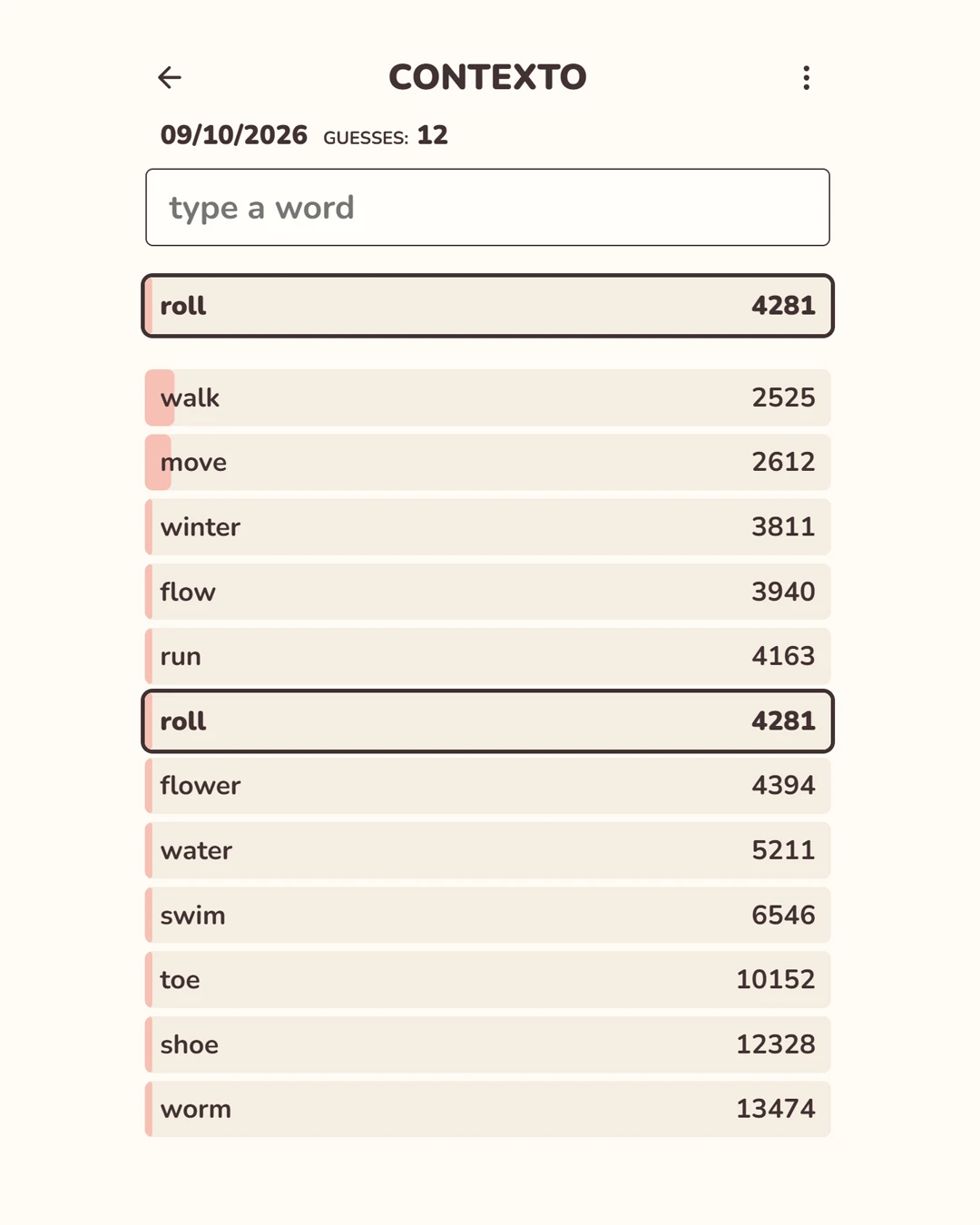
Contexto ranks guesses by semantic closeness to a secret word. Instead of matching spelling, players explore related ideas and use each rank to move from a broad topic toward the exact concept chosen for the day.
| Goal | Find a secret word using the semantic rank returned for each guess. |
|---|---|
| Category | Word games |
| Where to play | Contexto on the publisher’s website |
WHY WE PUT IT ON THE SHELF
The joy is in following a strange thought trail until one word suddenly makes the whole map make sense.
Every path ends at POOP.
The fixed finish turns a word ladder into a little route-planning problem. Every move feels useful when the path starts to open.

Find a word between your best guesses.
A smart change of pace from Wordle: you are narrowing a space, not chasing letter colors. The best guesses feel wonderfully surgical.

Guess the diagnosis, one clue at a time.
The case format makes every extra clue feel earned. It is more about weighing evidence than pretending to be a doctor.

Seven letters. Just twelve words to make them count.
Twelve slots make every little word feel like a decision. Holding back for a longer find is the satisfying part of this flower.
Solve sixteen Wordle-style boards in twenty-one guesses.
Sixteen boards sound absurd until the same good opener lights them all up. The satisfying part is deciding which half-solved word deserves your next guess.

Six tries to find the daily five-letter word.
The whole pleasure is one more informed guess. Six rows is enough for a small ritual, and the colored grid is easy to share without explaining the rules again.
Contexto is a word search by meaning rather than spelling. You enter words and receive a semantic rank, then use that feedback to move through related ideas until you reach the secret word at rank one.
For the current rules and available modes, consult the Contexto publisher. The steps above are CasualAtlas’s summary.
Stuck on a warm word? Learn how to read the hints without revealing today’s word.
Contexto is a daily word game that compares guesses with a hidden word using semantic similarity. The publisher explains that its algorithm analyzed large amounts of text to place words according to the contexts in which they occur. A submitted guess receives a position in that ranking; the secret answer occupies number one. You can keep trying words, so the challenge is not a fixed six-guess limit but finding a productive direction among many possible associations.
This is not a thesaurus test with a single obvious synonym. Words can be close because they are used in related situations, even if they are not interchangeable. For example, a place, a profession, and an object might all cluster around one topic. A guess that feels like the perfect synonym to a human reader may score less well than a word that occurs near the target in many texts.
Enter a broad, ordinary noun to establish a starting rank. If the number is distant, try a different topic rather than making tiny variations on the same guess. When a word ranks relatively close, explore the neighboring concepts: objects, people, actions, places, and categories associated with it. Keep your best-ranked guesses visible as anchors so each new attempt tests a hypothesis about the target’s semantic neighborhood.
Rank values are relative, not a percentage chance that your guess is correct. A lower position means the word is closer in the game’s model, and position one is the target. The live interface and accepted vocabulary may change, so check the official publisher for the current puzzle and any available help. CasualAtlas does not have access to the hidden word or the underlying ranking database.
A useful opening strategy samples unrelated themes. Try a place, an animal, a tool, a feeling, and an activity rather than five near-synonyms of the first word. This gives a rough map of where the target might live. Once one theme produces a substantially better rank, narrow the search inside it. If “kitchen” is warm, test ingredients, equipment, rooms, actions, and jobs rather than simply trying more building names.
When progress stalls, change the relationship you are testing. If several objects are warm, perhaps the answer is the activity that uses them. If a profession ranks well, perhaps the secret word is its workplace or product. Semantic models often connect co-occurring words, not only members of the same category. Moving sideways through a topic can therefore be more valuable than drilling deeper into a single list of synonyms.
A surprising warm word is evidence, not a bug. It may point toward a context you did not consider, such as a shared location, phrase, or cultural association. Write down the best few guesses and ask what situation could connect all of them. If two strong words seem unrelated, the intersection between their contexts may be the real clue. This is often where a broad search turns into a solvable puzzle.
Do not treat the ranking as a dictionary definition of meaning. An algorithm trained on text reflects patterns of usage, which can include common phrases and uneven representation of topics. A human judgment about synonymy may not match its order. Use the score as feedback about the game’s model and revise your search path accordingly rather than arguing with a single rank.
Use the Play Contexto link above for the current secret word and live ranking feedback. CasualAtlas is an independent directory and guide; it does not mirror the model or publish daily solutions. If you want to preserve the satisfaction of discovery, avoid answer pages until you have tried a few distinct semantic branches.
Betweenle offers an instructive contrast. It also hides a word, but feedback is alphabetical: each guess becomes a boundary in a sorted list. Contexto instead asks you to navigate a network of meanings. Worldle provides a geography counterpart in which feedback consists of direction, distance, and proximity. Moving between these games is a quick lesson in how different kinds of evidence lead to different search strategies.
Find the secret word by following semantic-rank feedback.
The secret word occupies position one in the game’s ranking.
No. Contexto uses similarity in the contexts where words occur.
No. Related objects, places, and activities can also rank close.
The publisher’s how-to-play explanation describes unlimited guesses.
The model compares usage contexts, which need not match a human synonym list.
Test a different relationship, such as a workplace, tool, activity, or broader category.
No. This guide does not mirror the official puzzle or its answer database.
Contexto ranks by meaning; Betweenle narrows alphabetically.
Follow the official publisher link at the top of this page.
Rules and live game: official Contexto website . CasualAtlas is an independent guide and is not affiliated with the publisher.