
Daily case puzzle · Logic game

Doctordle
 Doctordle
THE ORIGINAL DAILY GAME
Ready for today’s Doctordle?
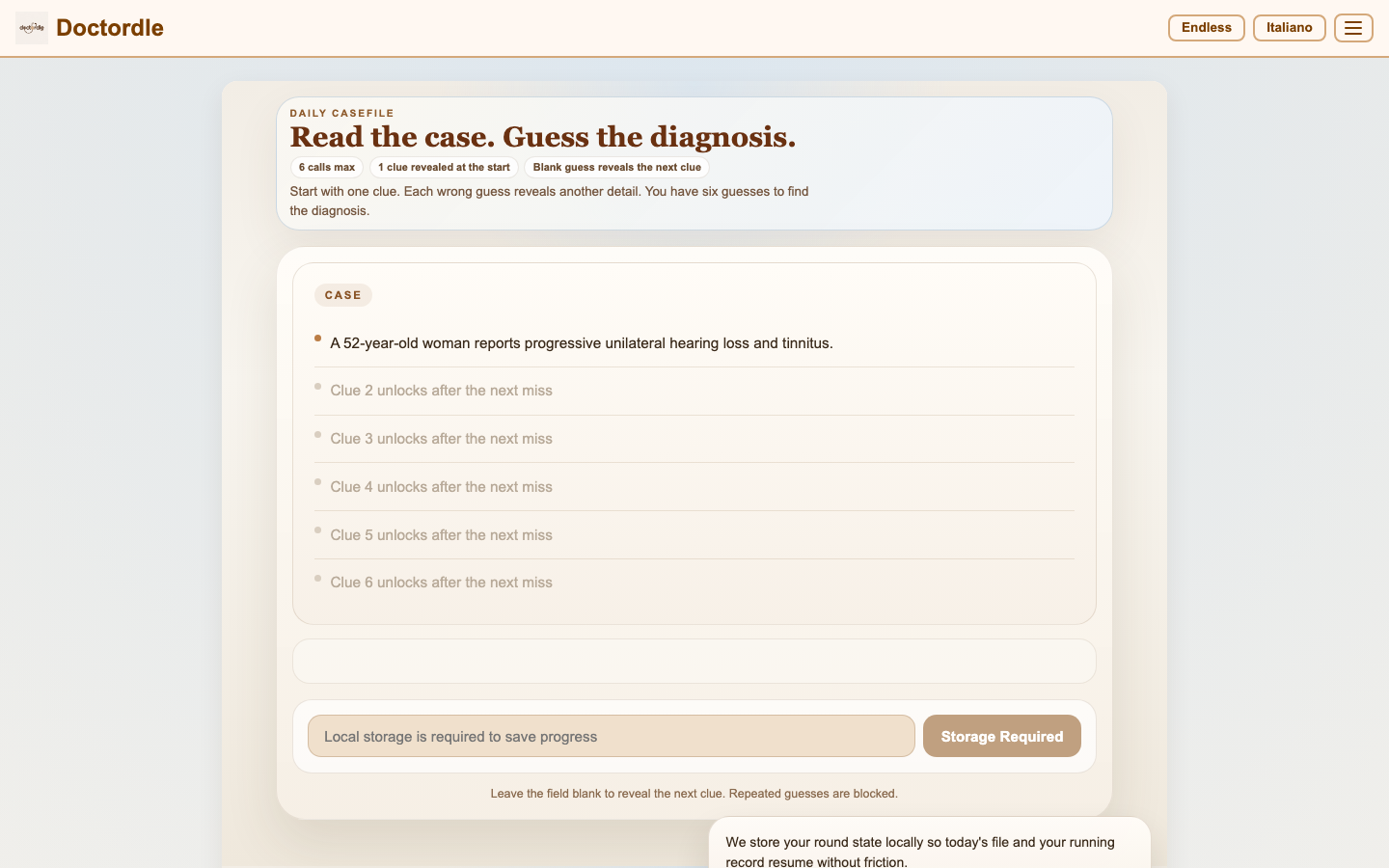
Guess the diagnosis, one clue at a time. The original game opens on its publisher’s website in a new tab.
THE SHORT VERSION
Doctordle at a glance
Doctordle turns a short fictional clinical case into a six-step daily deduction puzzle. Each incorrect guess reveals another detail, so the challenge is deciding when the evidence is strong enough to commit and when one more clue is worth waiting for.
| Goal | Identify the diagnosis in a short fictional case using no more than six progressively revealed clues. |
|---|---|
| Category | Logic games |
| Where to play | Doctordle on the publisher’s website |
Related games




Doctordle presents a short fictional patient case and asks you to identify the diagnosis before six clues run out. This independent guide explains the daily rules, a careful evidence-first approach, and the important boundary between solving a puzzle and making a real medical decision.
Start Doctordle in three steps
- Read the opening case detail and form more than one possible explanation.
- Submit a supported diagnosis or wait for another clue instead of forcing an early answer.
- Review the result summary after the round and keep the game separate from real health decisions.
“Six guesses. One new clue each round.”
The publisher describes one daily patient case, an additional clue after each miss, and an end-of-round answer summary. It also states that the game is for entertainment and is not medical advice.
What is Doctordle?
Doctordle is a daily diagnosis-guessing game built around a compact clinical vignette. The opening clue gives part of a fictional patient presentation. You can submit a diagnosis immediately or wait for more information. Each incorrect attempt reveals another detail, creating a simple tension between an early solve and a better-supported answer. The official game currently allows six guesses and provides a result summary after the round.
The format resembles a logic puzzle more than a clinical tool. A clue may point toward several conditions at first, and later details narrow that set. Players with medical knowledge may recognize patterns sooner, but the interface is readable without professional training. The publisher also offers an Endless area for additional cases after the daily puzzle, including Challenge and Practice modes.
How to play Doctordle
Read the first clue once and separate observations from interpretations. Age, timing, location, and the main complaint are observations; the diagnosis you associate with them is a hypothesis. Keep two or three possible explanations in mind instead of locking onto the first familiar condition. If one diagnosis clearly explains every stated detail, submit it. If the evidence is still broad, allow the next clue to do useful work.
After a miss, do not simply repeat a synonym. Ask what the new clue changed. Did it make the onset more acute, identify a body system, introduce a risk factor, or rule against your leading idea? Update the shortlist and choose the diagnosis that explains the complete case with the fewest exceptions. Once the round ends, review the answer summary rather than treating a correct title alone as proof that your reasoning was sound.
Build a differential before you commit
A useful puzzle habit is to group candidates instead of guessing one isolated label. Start with a broad category suggested by the complaint, then list a common possibility, a serious alternative, and a different mechanism that could look similar. This small differential protects against anchoring: the tendency to cling to the first idea even after later clues stop fitting it.
Compare candidates with the exact wording on screen. One condition may fit the symptom but not the patient profile or time course. Another may explain the timing but conflict with a later physical finding. Doctordle rewards restraint because another clue can remove an entire branch of possibilities. An early guess feels satisfying, but a later supported guess is better than a random first-round hit.
When to guess and when to wait
Guess when one option explains nearly all available details and the nearest alternatives require assumptions not present in the case. Wait when the clue is common to many conditions, when the patient context is still missing, or when your candidates would be separated by a test, sign, or timeline that has not appeared. The goal is not to avoid all uncertainty; it is to recognize whether the uncertainty is informative or merely broad.
Use each revealed clue as a decision point. If it confirms the leading diagnosis and weakens the others, commit. If it only adds another nonspecific symptom, preserve the shortlist. This approach also makes mistakes easier to understand. You can identify the clue you overweighted, the alternative you ignored, or the moment when waiting would have produced decisive evidence.
Daily case, Endless, and the archive
The homepage centers on one featured daily case. Doctordle Endless removes that stopping point for a longer session: Challenge Mode adds streak pressure, while Practice Mode is designed to move directly into another case. The publisher also lists an archive, which is useful when you want an earlier case rather than a random practice run. Check the mode label before comparing results because a daily solve and a practice session serve different purposes.
For focused play, finish the daily case first and review why the answer fits. Use Endless only if another round still feels useful. Rapidly clicking through many cases can turn the activity into title recognition rather than reasoning. A short note about the decisive clue gives each round a clearer end and makes repeated practice more meaningful.
A game is not medical advice
Doctordle states that it is for entertainment and does not constitute medical advice. Its cases are puzzle material, not a way to diagnose yourself or another person. Real symptoms require history, examination, testing, and professional judgment that a short web vignette cannot provide. A game answer should never be used to start, stop, or change treatment.
If you have a health concern, contact a qualified medical professional or the appropriate local service. Use Doctordle to enjoy structured deduction and pattern recognition, then leave the reasoning inside the game. CasualAtlas links to the publisher and explains the format; it does not provide clinical recommendations, symptom assessment, or a diagnosis checker.
Doctordle questions, answered
01How many guesses does Doctordle allow?
The official daily game currently provides up to six guesses, with another clue after each miss.
02Is there one Doctordle case each day?
The homepage features one daily case. The publisher also offers Endless modes for additional cases.
03What happens after an incorrect diagnosis?
Another detail from the fictional case is revealed so you can revise the shortlist.
04Do I need medical training to play?
No. Medical knowledge can make patterns more familiar, but the clue-by-clue puzzle is open to general players.
05What is the best first step?
Separate the facts in the opening clue from your interpretation, then keep more than one possible diagnosis in mind.
06Should I guess immediately?
Guess when one option explains the evidence clearly; otherwise wait for a clue that can separate your leading candidates.
07What is Doctordle Endless?
It is the publisher’s repeat-play area, with Challenge and Practice modes beyond the featured daily case.
08Does Doctordle give medical advice?
No. The publisher states that the game is for entertainment and is not medical advice.
09Can I use Doctordle to diagnose symptoms?
No. A short fictional case cannot replace evaluation by a qualified medical professional.
10Does CasualAtlas host Doctordle?
No. CasualAtlas provides an independent guide and links to the publisher’s live game.
Rules and live game: official Doctordle website . CasualAtlas is an independent guide and is not affiliated with the publisher.