
Daily price puzzle · Logic game

Costcodle
 Costcodle
THE ORIGINAL DAILY GAME
Ready for today’s Costcodle?
Guess the price of a real Costco product in six tries. The original game opens on its publisher’s website in a new tab.
THE SHORT VERSION
Costcodle at a glance
Costcodle shows one Costco product and asks you to estimate its price. Each submitted amount receives higher-or-lower feedback, turning shopping instincts into a daily number-guessing puzzle. The item and its pack size matter more than a generic idea of what that type of product costs.
Related games
Explore Logic



Board game · Browser game
Dominoes Online
Match tiles and outplay the computer in three classic modes.
Costcodle turns a Costco product listing into a daily price puzzle. The trick is to estimate the price of the specific package on screen, not the usual price of a vaguely similar item. Here is how to use the clues from each guess without mistaking a lucky estimate for a reliable shopping rule.
What is Costcodle?
Costcodle presents a product sold at Costco and asks you to guess its listed price. You see the product image and name, then enter a dollar amount. The game gives you six attempts, with feedback showing whether each estimate is higher or lower than the answer. A guess within the game's accepted range wins. It is a short daily challenge built around everyday retail intuition rather than memorizing obscure trivia.
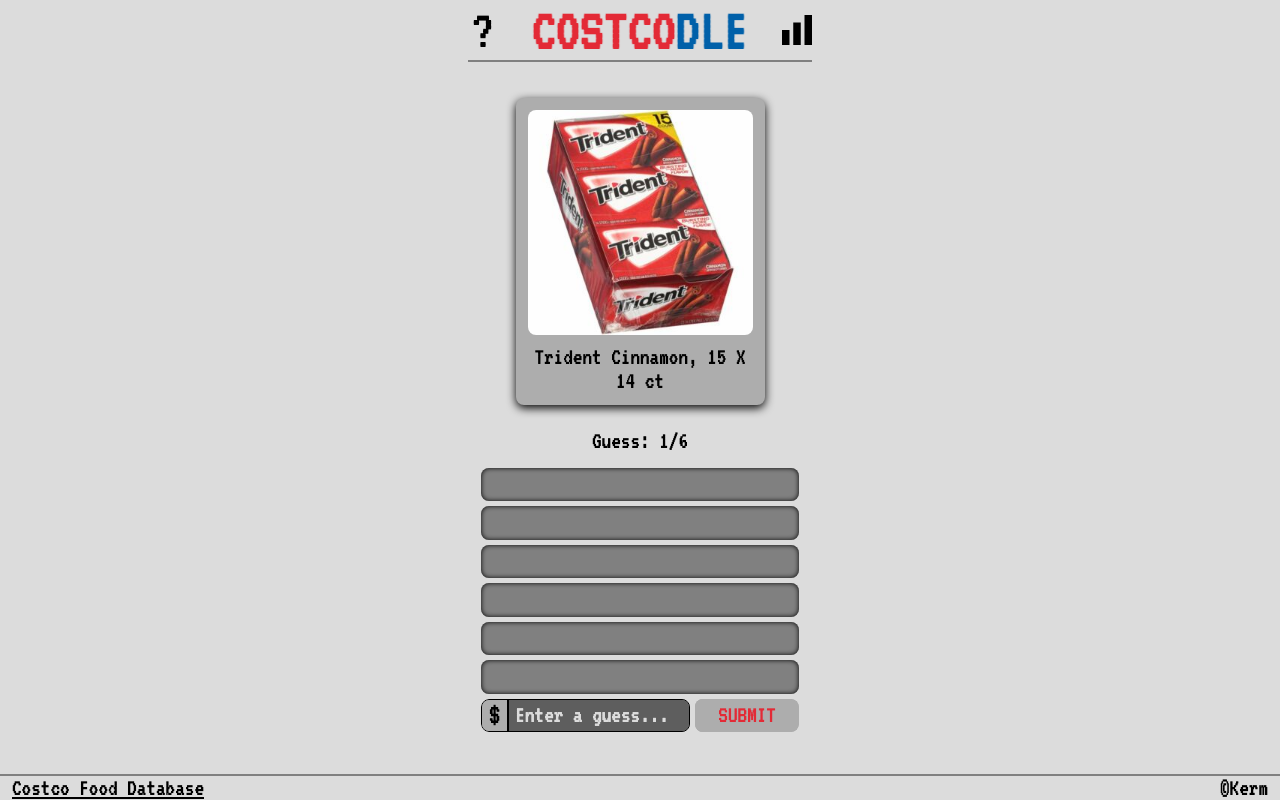
The packaging is the most important clue. Costco frequently sells larger quantities and multi-packs, so the price of a familiar brand at a regular grocery store may be a poor starting point. Read the entire product title, including its count, weight, and flavor or model, before you choose a number. Two items that look similar in a thumbnail can have very different package sizes and therefore very different prices.
How to play the daily price puzzle
Open the publisher's game, inspect the pictured item, and submit a price in dollars. After the first guess, use the high-or-low feedback to put a boundary around the answer. Keep each later amount inside the remaining plausible interval. If you guessed twenty dollars and the game says the real price is higher, an even lower second guess cannot add useful information. Think of each entry as a test that should narrow the range.
You do not need to hit the exact cent value to enjoy the challenge. The publisher explains that an estimate within five percent of the actual price counts as a win. That tolerance changes how to plan the final attempt: when you already have a tight range, a sensible central guess may be better than chasing an unlikely precise price ending. Always use the result shown by the live game as the authority for that day.
Build a better first estimate
Start by identifying the product category: pantry food, household supplies, electronics, clothing, or something else. Then look for the unit that determines value. A case of drinks should be considered by bottle count and size; a snack assortment depends on the number of individual bags; a device may require attention to model and accessories. This approach gives you an anchor even when you have never seen the exact Costco listing.
Treat the photo as supporting evidence, not as the whole description. A close crop can make a bulk pack look like a single item, and different varieties of the same brand can have different prices. If the name includes a count such as fifteen packs, account for that before guessing. When no quantity is visible, admit the uncertainty and choose a wider opening estimate instead of inventing details that are not on screen.
Use feedback without wasting guesses
The simplest method is to maintain a lower and upper bound. A too-low guess raises your floor; a too-high guess lowers your ceiling. Your next estimate should divide the remaining plausible price interval while still reflecting what the product could realistically cost. For example, if you know only that the price is above your first modest estimate, jumping to an extreme number may be less helpful than testing a middle value.
Do not assume price endings carry more information than the direction signal. Many retailers use familiar endings, but the daily listing may include an unusual amount or a temporary price. The goal is to discover the answer through structured guesses, not to reverse-engineer a store-wide rule from one item. If your final attempt misses, compare the real package size with your first assumption to learn why the estimate drifted.
What the result does and does not tell you
A Costcodle answer reflects the product and price used by that day's publisher puzzle. It is not a live quote for your nearest warehouse and should not be treated as a shopping recommendation. Regional availability, timing, taxes, discounts, and package changes can all matter in the real world. If you want to buy the item, verify the current listing through Costco rather than relying on a game result or an old shared screenshot.
There is also a useful difference between being close and being informed. A lucky first guess is satisfying, but a well-reasoned sequence of estimates teaches you more about quantities and price ranges. If you like number feedback, try Colorfle for a visual version of narrowing a target. If you prefer a surprising daily draw, RNGdle focuses on mathematical patterns instead of product prices.
Where to play Costcodle
Use the Play Costcodle button above to visit costcodle.com. CasualAtlas links to the live puzzle and provides this independent guide; it does not host the product database, set the daily answer, or reproduce an unlimited edition. The screenshot on this page identifies the game interface and may show a different product from the one available when you click through.
For a short daily routine, pair Costcodle with one game that rewards a different kind of judgment. Scrandle asks you to anticipate how other people rate stadium food, while Travle tests geographic routes. Moving between price estimation, social prediction, and map knowledge keeps the challenge varied without turning a quick break into a long session.
Costcodle questions, answered
01What do you guess in Costcodle?
You estimate the displayed Costco product's price in dollars.
02How many guesses do I get?
The publisher currently provides six attempts for the daily item.
03Must I enter the exact price?
The publisher says a guess within five percent of the actual price counts as a win.
04What does the feedback tell me?
It indicates whether your submitted amount is above or below the answer.
05Should I compare a single-item grocery price?
Only after checking the item count and package size; Costco listings often cover bulk quantities.
06Is the displayed amount a current local warehouse price?
Not necessarily. The game uses a puzzle price, while local prices and availability can change.
07Does CasualAtlas publish today's answer?
No. The live publisher game supplies the daily product and result.
08Can I play the original game here?
Follow the Play Costcodle link to the publisher's website.
09What is a good first-guess method?
Read the full product name, identify the unit or pack size, then estimate the total package price.
10Why was my estimate far off?
A pack count, product model, or unusual size may differ from the comparable item you had in mind.
Rules and live game: official Costcodle website . CasualAtlas is an independent guide and is not affiliated with the publisher.