RNGdle turns a randomly presented number into a compact daily reasoning prompt. The fun is not only in the result: players notice repeated digits, symmetry, factors, sequences, and other properties that make an ordinary-looking number unexpectedly memorable.
RNGdle quick reference
Goal
Roll a number from 0 to 1,000,000, then discover its badges and entropy points (EP).
Match tiles and outplay the computer in three classic modes.
EDITOR'S TAKE
A quiet board-game break with enough tactical choices to stay interesting, even when you only have time for one round.
5–10 min
Easy start
RNGdle makes one random number feel worth inspecting. This guide explains the daily roll, the distinction between number rarity and badge rarity, and ways to enjoy patterns without treating a lucky-looking result as a prediction about tomorrow.
Start RNGdle in three steps
Open the official game and generate your daily number.
Read the badges awarded for that number and compare their conditions with its digits.
Review the total EP and overall rarity, then save or share the result through the game.
The official explanation lists seven number-rarity tiers by total EP and six badge-rarity tiers by roll probability. The public home and About pages do not link to an official sandbox.
What is RNGdle?
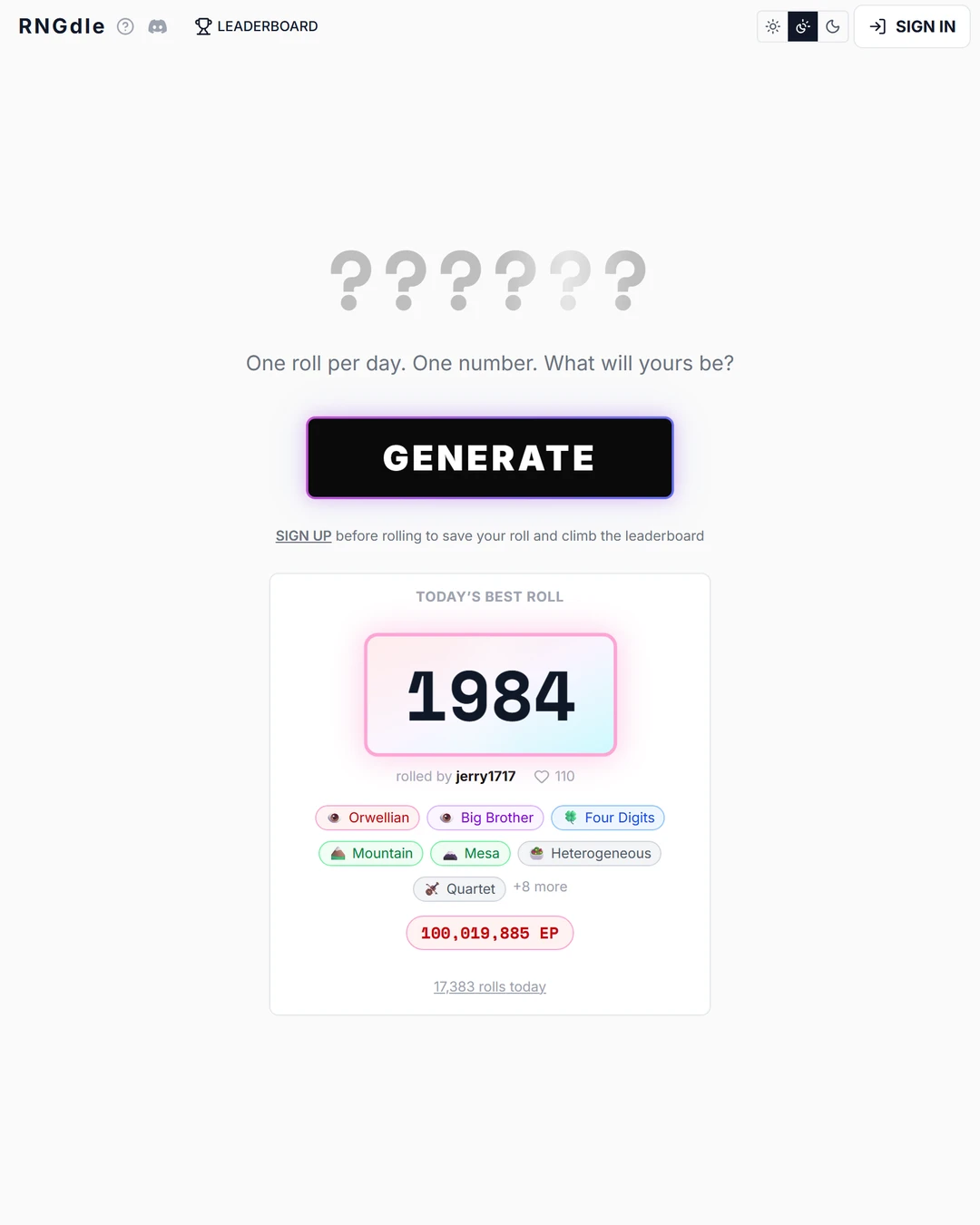
RNGdle is a daily random-number game rather than a conventional word or logic puzzle. The official game gives each player one roll for the day, drawing a number from zero through one million. It then inspects that result for recognizable properties and awards badges and entropy points, or EP. The pleasure comes from discovering what is hiding in a number you did not choose. A plain-looking result may contain a sequence or mathematical property that is easy to miss at first glance.
Unlike a guessing game, RNGdle does not reward a better answer to a fixed question. The roll is the event; the interpretation comes afterward. Two players can receive very different numbers and compare their collections of badges. That makes it closer to a daily discovery ritual than a skill test. A low-scoring roll is still a valid result, and the game is more enjoyable when you treat the rarity label as a description of this draw rather than a judgment of how well you played.
How the daily roll works
Open the official RNGdle site and press the roll button once. The result page identifies patterns such as repeated digits, palindromes, primes, or sequences when the number qualifies. Take a moment to read the badges before looking only at the overall label. A property may be surprising even when the total EP is not especially high. The site also lets players build a badge collection over time and share an interesting daily result with friends.
The one-roll format matters. There is no sensible strategy for forcing a better number on a particular day, because the number is generated at random. If you are curious about a pattern, examine the digits themselves: does the sequence read the same backward, repeat a block, or contain a run? Then compare that visible property with the badge explanation. Do not confuse noticing a pattern after the draw with predicting it beforehand.
Number rarity is not badge rarity
The official game uses two different scales. Number rarity compares your roll’s total entropy points (EP) with all possible results. Badge rarity describes how often a particular badge condition occurs. A rare badge therefore does not automatically make the whole number a top-tier roll. The tables below reproduce the publisher’s tier boundaries so you can read the label shown after your daily roll.
The boundaries are definitions, not a calculator. CasualAtlas does not compute your official EP or percentile. For an individual badge’s probability and EP value, use our badge directory; for checkable digit and mathematical traits without a claimed official score, use the number-pattern explainer.
Start with the shape of the digits. A repeated digit, a mirrored arrangement, or a neat ascending run is immediately visible. Next consider arithmetic properties that are less obvious at a glance: divisibility, factors, or whether the number is prime. A result can have more than one interesting feature, and the combination may be the reason it feels memorable. Check the actual badge description before assigning your own meaning to a pattern; the official conditions can be narrower than an informal observation.
It also helps to remember selection bias. People tend to share striking rolls and ignore ordinary ones, so a social feed makes special-looking numbers appear more common than they are in a complete sequence of draws. Conversely, any specific six-digit result is unusual if described after the fact. The useful question is not whether your number feels fated, but which predefined property it has and how the game evaluates that property across possible rolls.
Where to play and what to explore next
Use the Play RNGdle button above to visit the official publisher for the daily roll, current badge rules, and your actual score. CasualAtlas does not host the game or reproduce its database of rarity outcomes. Our number explainer is an independent companion for players who want to inspect a result more carefully after rolling. It deliberately avoids presenting a made-up official percentile, even when a pattern looks particularly striking.
If you like the surprise of a daily result, Krillion offers another way to think about rarity: instead of a random number, it asks for uncommon answers under a timer. If you prefer deliberate deduction, Colorfle gives feedback on color composition, while Betweenle narrows a word by alphabetical position. Those games use very different skills, which is exactly why comparing them can keep a short daily routine fresh.
RNGdle questions, answered
01What is RNGdle?+
A daily game that gives you one random-number roll, then identifies patterns and awards badges and EP.
02What range can the number come from?+
The official explanation currently says the roll is from zero through one million.
03Can I reroll the daily number?+
The official daily format gives one roll per day.
04What does EP mean?+
EP stands for entropy points, the score used by the game when comparing roll rarity.
05Is a rare badge the same as a rare number?+
No. Badge rarity describes a property, while overall number rarity uses the roll’s total EP.
06Does CasualAtlas calculate official RNGdle rarity?+
No. Its number explainer identifies mathematical traits without claiming an official score or percentile.
07Does a palindrome guarantee a top-tier roll?+
Not necessarily. The overall tier depends on the publisher’s scoring of all awarded properties.
08Can I improve my odds with a strategy?+
You cannot control a random daily roll; you can only learn to recognize and understand its properties.
09What should I do after rolling?+
Read each badge, compare it with the digits you received, and share the result if you enjoy it.
10Where is the actual game?+
Use the official publisher link on this page; CasualAtlas is an independent guide.
Rules and live game: official RNGdle website . CasualAtlas is an independent guide and is not affiliated with the publisher.