
One letter at a time · Original
Poople Guide: Word Ladder Rules and Routes
Every path ends at POOP.
EDITOR'S TAKE
The fixed finish turns a word ladder into a little route-planning problem. Every move feels useful when the path starts to open.
16 word boards · Word game

 Sedecordle
THE ORIGINAL DAILY GAME
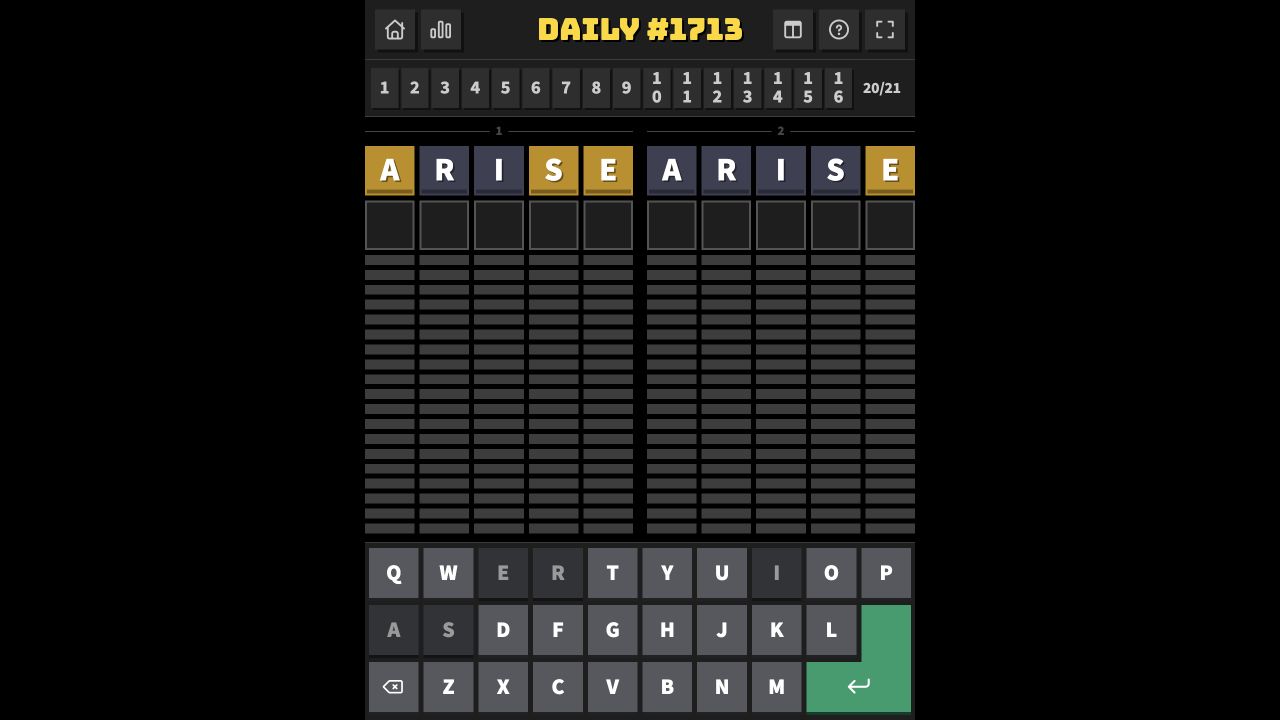
Solve sixteen Wordle-style boards in twenty-one guesses. The original game opens on its publisher’s website in a new tab.
THE SHORT VERSION
Sedecordle plays one five-letter guess across sixteen different hidden words at once. The challenge is to read sixteen sets of feedback without losing track of the twenty-one-guess budget. Its official site offers a daily puzzle and a practice mode.
| Goal | Find sixteen hidden five-letter words within twenty-one shared guesses. |
|---|---|
| Category | Word games |
| Boards | 16 |
| Guesses | 21 shared across every board |
| Modes | Daily and Practice |
| Where to play | Sedecordle on the publisher’s website |
WHY WE PUT IT ON THE SHELF
Sixteen boards sound absurd until the same good opener lights them all up. The satisfying part is deciding which half-solved word deserves your next guess.
Every path ends at POOP.
The fixed finish turns a word ladder into a little route-planning problem. Every move feels useful when the path starts to open.

Find a word between your best guesses.
A smart change of pace from Wordle: you are narrowing a space, not chasing letter colors. The best guesses feel wonderfully surgical.

Follow meaning until the word clicks.
The joy is in following a strange thought trail until one word suddenly makes the whole map make sense.

Guess the diagnosis, one clue at a time.
The case format makes every extra clue feel earned. It is more about weighing evidence than pretending to be a doctor.

Seven letters. Just twelve words to make them count.
Twelve slots make every little word feel like a decision. Holding back for a longer find is the satisfying part of this flower.

Six tries to find the daily five-letter word.
The whole pleasure is one more informed guess. Six rows is enough for a small ritual, and the colored grid is easy to share without explaining the rules again.
Sedecordle takes the familiar five-letter guessing format and spreads it across sixteen hidden words. You have twenty-one shared guesses, and each word you enter updates every board at once. This independent guide explains the rules, a workable way to manage sixteen color patterns, and when the official practice mode is more helpful than another daily attempt.
“16 different words must be found within 21 guesses.”
The official Help screen describes one guess affecting all sixteen words. The home screen lists Daily, Practice, Sedec-order, Savior and Variations.
The original Sedecordle asks you to solve sixteen different five-letter words in one game. The daily screen shows sixteen numbered boards and a single remaining-guess counter. You do not get twenty-one guesses per word. Every valid word you submit consumes one of twenty-one attempts for the entire puzzle, while the resulting letters appear across all sixteen boards. A correct answer finishes its own board; the other unsolved boards continue to receive information from later guesses.
This makes Sedecordle a different kind of challenge from playing sixteen separate Wordles in a row. An opener can be poor for one board and excellent for another. The important skill is moving attention between boards without forgetting a nearly complete answer. The publisher’s homepage currently offers both a Daily game and Practice, so you can learn the interface without treating your first real daily round as a tutorial.
Think of each guess as a broadcast. Enter one valid five-letter word, then inspect what that word taught you on several boards before entering another. Letters in the right position, letters present elsewhere, and missing letters are evaluated separately for each hidden word. A dark letter on one board does not prove the letter is absent from the other fifteen. Keeping the feedback tied to its board is the central discipline of the game.
Twenty-one guesses leave little room to solve words one by one without planning, but there is no need to stare at every board after every turn. Group them. Which boards already have most letters placed? Which still need broad vowel or consonant coverage? Which have an obvious word you can finish now? As solved boards accumulate, later guesses become easier to choose because fewer unsolved patterns are competing for your attention.
Early guesses should reveal common letters across many boards. A word with several distinct, frequently used letters can help more than an obscure answer chosen because it fits one board perfectly. After the first couple of turns, stop treating the puzzle as a generic letter search. Compare the actual patterns you have. If many boards share a missing vowel, test that vowel in a word that also advances one or two near-solutions.
Avoid entering a string of broad test words simply because that feels systematic. Each one uses the same limited budget you need for final answers. The strongest midgame guess often solves a clear board and still reveals useful letters elsewhere. When a word fits only one tempting board but creates no information on the others, ask whether another board is closer to completion or whether that answer can wait.
Use the numbered board navigation as a checklist. After each turn, mark in your mind which boards are solved, which are one letter away, and which still have too many possibilities. It helps to work in short passes rather than scrolling repeatedly from the first board to the last. A board with a strong pattern may deserve an immediate answer; a sparse board can wait until another shared guess supplies letters at no extra information cost.
Near the end, count unresolved boards against the remaining guesses. If three words remain and only three guesses are available, every entry must be a likely solution. This is the point to slow down and check duplicate letters, position constraints, and alternative spellings carefully. Losing at sixteen boards can feel chaotic, but the final mistakes are usually local: one color was read from the wrong board or a candidate was submitted before checking its pattern.
The official Sedecordle menu lists Daily game and Practice. Daily gives everyone a shared puzzle, while Practice is the place to learn how the boards and controls behave. The same menu also advertises Sedec-order, where words are solved one at a time, and Savior, where the first four words are chosen for you. A Variations entry offers versions with different word lengths, from four to eleven letters. These are publisher modes, not separate CasualAtlas games.
If sixteen simultaneous boards are overwhelming, spend a few practice rounds focusing on navigation and feedback rather than trying to win immediately. You can decide which kind of play you enjoy before committing to the daily. CasualAtlas does not publish a daily answer or claim to host an unlimited Sedecordle; use the official link for live puzzles and current mode availability.
Quordle and Octordle ask you to watch fewer boards at once; Sedecordle doubles down on the bookkeeping. The number of shared guesses matters as much as the number of words. A strategy that works with four puzzles can become expensive when sixteen different answers all need room in the same attempt budget. That is why a high-information opener and a deliberate board-order habit matter more here than in a single-grid game.
If your favorite part of word games is a quiet chain of deductions, start with a smaller multi-board format and return when tracking several patterns feels natural. If you already like managing overlapping clues, Sedecordle offers a satisfying longer session. Betweenle and Blossom on CasualAtlas are alternatives with different mechanics: one narrows an alphabetical interval, while the other rewards selective word building. Neither is a replacement for the sixteen-board challenge.
Prefer a different word challenge? Try Betweenle for alphabetical deduction or Blossom for selective word building.
Sixteen different hidden words are in the original game.
Twenty-one guesses are shared across all sixteen boards, not twenty-one for each board.
Yes. Each valid five-letter guess produces separate feedback on every active board.
Yes. The publisher lists Practice alongside the Daily game.
An official variation in which the words are solved one at a time.
An official variation where the first four words are chosen for you.
The official Variations menu advertises word lengths from four to eleven letters.
No. It uses a related letter-feedback mechanic across sixteen different answer boards.
Finish clear words when helpful, but choose early guesses for information across multiple boards.
No. This guide explains how to play and links to the original publisher.
Rules and live game: official Sedecordle website . CasualAtlas is an independent guide and is not affiliated with the publisher.