
Daily · Original
Betweenle Strategy: Narrow the Alphabet Gap
Find a word between your best guesses.
EDITOR'S TAKE
A smart change of pace from Wordle: you are narrowing a space, not chasing letter colors. The best guesses feel wonderfully surgical.
One letter at a time · Word game

 Poople
THE ORIGINAL DAILY GAME
One four-letter word, one destination, and a fixed rule between them. The original game opens on its publisher’s website in a new tab.
THE SHORT VERSION
Poople is a daily word ladder with a visible starting point and a fixed finish. You are not hunting a hidden word; you are building the shortest path you can from the word on screen to POOP, one letter at a time.
| Goal | Change one letter per guess and reach POOP in as few steps as possible. |
|---|---|
| Category | Word games |
| Word length | 4 letters |
| New puzzle | 08:00 UTC |
| Where to play | Poople on the publisher’s website |
WHY WE PUT IT ON THE SHELF
The fixed finish turns a word ladder into a little route-planning problem. Every move feels useful when the path starts to open.
Find a word between your best guesses.
A smart change of pace from Wordle: you are narrowing a space, not chasing letter colors. The best guesses feel wonderfully surgical.

Follow meaning until the word clicks.
The joy is in following a strange thought trail until one word suddenly makes the whole map make sense.

Guess the diagnosis, one clue at a time.
The case format makes every extra clue feel earned. It is more about weighing evidence than pretending to be a doctor.

Seven letters. Just twelve words to make them count.
Twelve slots make every little word feel like a decision. Holding back for a longer find is the satisfying part of this flower.

Solve sixteen Wordle-style boards in twenty-one guesses.
Sixteen boards sound absurd until the same good opener lights them all up. The satisfying part is deciding which half-solved word deserves your next guess.

Six tries to find the daily five-letter word.
The whole pleasure is one more informed guess. Six rows is enough for a small ritual, and the colored grid is easy to share without explaining the rules again.
Poople asks a narrow question and answers it every day: how few moves does this ladder need? This guide covers the one-letter rule, what “extra guesses” actually measures, where your stats live, and how Unlimited practice differs from the daily board.
“Short routes usually keep the first P, find the double O, and solve the final P cleanly.”
The official page documents the one-letter rule, fixed target, route data, local statistics, daily rollover, and three interface languages.
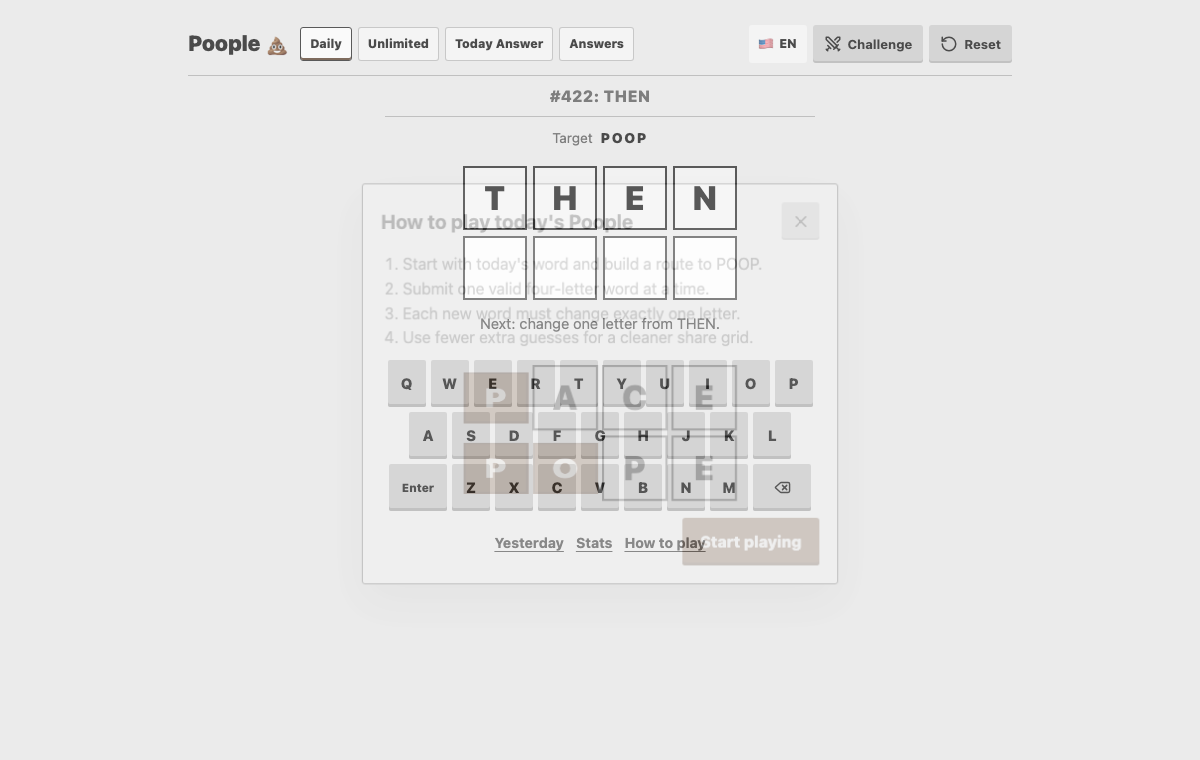
Poople is a daily word ladder game with a destination that never changes. Each puzzle gives you a four-letter starting word, and your job is to walk it to POOP by changing a single letter at every step. Every word in between has to be a real word. There is no hidden answer to discover because the starting word is visible from the first second: the puzzle is the path, not the target.
That makes it different from answer-hunting games. Poople rewards the shape of a route. Two players can finish the same board and compare step counts rather than answers, and a clean five-move route feels different from a scrappy nine-move one even though both boards read POOP at the end.
The format is deliberately small: four letters, one edit per move, one target. The publisher keeps the board, input, and keyboard at the top of the page so play can begin immediately. Rules, statistics, and language controls remain available without taking over the first screen, and the compact board works well on a phone.
Start from the four-letter word on the board. In the daily puzzle that word is shared by every player and changes once a day. Change exactly one character, not two and not a letter’s position. The result must be a real word accepted by Poople’s dictionary, then that new word becomes the starting point for the next move. Repeat until the word reads POOP.
Nothing else moves. The length stays at four letters, and the characters you keep stay in their positions. That tight constraint is why a ladder can feel easy for several moves and then jam: the closer the route gets, the more positions appear fixed and the smaller the useful set of legal edits becomes.
The publisher’s advice for shorter routes points to the shape of the target rather than a memorized list. Preserve a useful first P, find the double O, and leave a clean final change to P. Reading the finish before typing makes the middle of a route easier to evaluate.
Poople records extra guesses rather than treating the raw number of typed words as the only score. Extra guesses measure how many moves a completed route used beyond the shortest path calculated for that board. A route completed in five moves when five is optimal adds nothing extra; completing the same board in eight adds three. The publisher rolls those results into an average extra-guesses statistic that can improve over time.
Before play, the daily page also describes the ladder’s shape without revealing an answer word. It lists the shortest route length, how many different routes tie at that length, how many legal first moves exist, and how many of those first moves actually reduce the remaining distance to POOP.
The difference between the last two figures is especially useful. A start might have nine legal neighboring words but only two that gain ground, so the opening deserves more thought than simply entering the first valid word. Multiple equally short routes also mean more than one opening can keep a player on optimal pace. These figures refresh with the next puzzle and are computed from the publisher’s 5,395-word graph, checked October 10, 2026.
Poople publishes one shared starting word each day, with the next puzzle going live after 08:00 UTC, checked October 10, 2026. The daily mode tracks a current streak, best streak, average extra guesses, and completion distribution, giving route quality a place beside the usual streak count.
Those statistics stay in the browser. No account is required: streaks, completed games, and the current attempt are stored locally. Clearing site data, switching devices, or opening a private window therefore creates a separate history. That is the trade-off behind an instant, login-free daily game.
A completed board creates a compact emoji grid that describes route quality without revealing the words used. The interface is available in English, Spanish, and German; each language uses the same daily puzzle while its progress remains in the browser where it was played.
Unlimited practice fills the rest of the day. It preserves the one-letter rule and fixed target but replaces the single daily start with generated routes available on demand, without changing the daily streak. The practice bank, difficulty bands, and curated start words are documented separately so this page can stay focused on the daily game.
Continue with the Poople Unlimited guide for the practice bank, difficulty bands, and start-word selection.
Poople runs on its publisher’s website, where the current board, live route data, and actual score are calculated. CasualAtlas does not host, copy, or license the game, and this guide contains no daily answers or route solutions. Publisher statements are linked and dated so readers can check whether the underlying data has changed.
The publisher also maintains first-party word ladder statistics and patterns pages. The statistics report explains the generated graph, candidate pools, route lengths, and reviewed hard starts. The patterns report maps the words one move from POOP, distance bands, and highly connected hub words. Both use the same 5,395-word graph referenced by the daily board.
For another form of clue-driven word play, Contexto uses semantic distance while Betweenle narrows an alphabetical interval. Worldle applies the same process of reading feedback and reducing a search space to geography. Together they make a varied daily routine built around evidence rather than blind guesses.
Poople is a daily word ladder: start from a four-letter word and reach POOP by changing one letter at a time.
Four. Only one letter changes per move; the word length and character positions remain fixed.
No. Streaks, statistics, and current-day progress are stored locally in the browser.
The publisher currently rolls the daily puzzle over at 08:00 UTC.
Every move beyond the shortest route calculated for that board. The player’s average is built from those extra moves.
Not necessarily. The daily figures show how many routes tie at the shortest length, so several openings can sometimes stay on pace.
Yes. Poople Unlimited loads another generated practice route whenever you want one.
No. The daily streak belongs to the shared daily board; Unlimited practice is separate.
No. This page explains rules and route data but publishes no daily answers or solutions.
The game is on Poople.org, linked from the Play Poople button. CasualAtlas is an independent guide.
Rules and live game: official Poople website . CasualAtlas is an independent guide and is not affiliated with the publisher.