
One letter at a time · Original
Poople Guide: Word Ladder Rules and Routes
Every path ends at POOP.
EDITOR'S TAKE
The fixed finish turns a word ladder into a little route-planning problem. Every move feels useful when the path starts to open.
Daily · Word game

 Betweenle
THE ORIGINAL DAILY GAME
Find a word between your best guesses. The original game opens on its publisher’s website in a new tab.
THE SHORT VERSION
Betweenle asks you to locate a hidden word by interpreting where each guess falls in alphabetical order. The shrinking interval turns vocabulary into a search problem: every answer should divide the remaining space and reveal a more useful boundary.
| Goal | Find a hidden word by narrowing the alphabetical interval around it. |
|---|---|
| Category | Word games |
| Where to play | Betweenle on the publisher’s website |
WHY WE PUT IT ON THE SHELF
A smart change of pace from Wordle: you are narrowing a space, not chasing letter colors. The best guesses feel wonderfully surgical.
Every path ends at POOP.
The fixed finish turns a word ladder into a little route-planning problem. Every move feels useful when the path starts to open.

Follow meaning until the word clicks.
The joy is in following a strange thought trail until one word suddenly makes the whole map make sense.

Guess the diagnosis, one clue at a time.
The case format makes every extra clue feel earned. It is more about weighing evidence than pretending to be a doctor.

Seven letters. Just twelve words to make them count.
Twelve slots make every little word feel like a decision. Holding back for a longer find is the satisfying part of this flower.
Solve sixteen Wordle-style boards in twenty-one guesses.
Sixteen boards sound absurd until the same good opener lights them all up. The satisfying part is deciding which half-solved word deserves your next guess.

Six tries to find the daily five-letter word.
The whole pleasure is one more informed guess. Six rows is enough for a small ritual, and the colored grid is easy to share without explaining the rules again.
Betweenle turns alphabetical order into a narrowing search problem. Each accepted guess tells you which side of that word the secret answer occupies, so a successful solve depends on choosing informative words rather than firing off vocabulary at random.
For the current rules and available modes, consult the Betweenle publisher. The steps above are CasualAtlas’s summary.
Looking for the daily word? Use the Betweenle answer verification guide to check the live result without trusting a stale list.
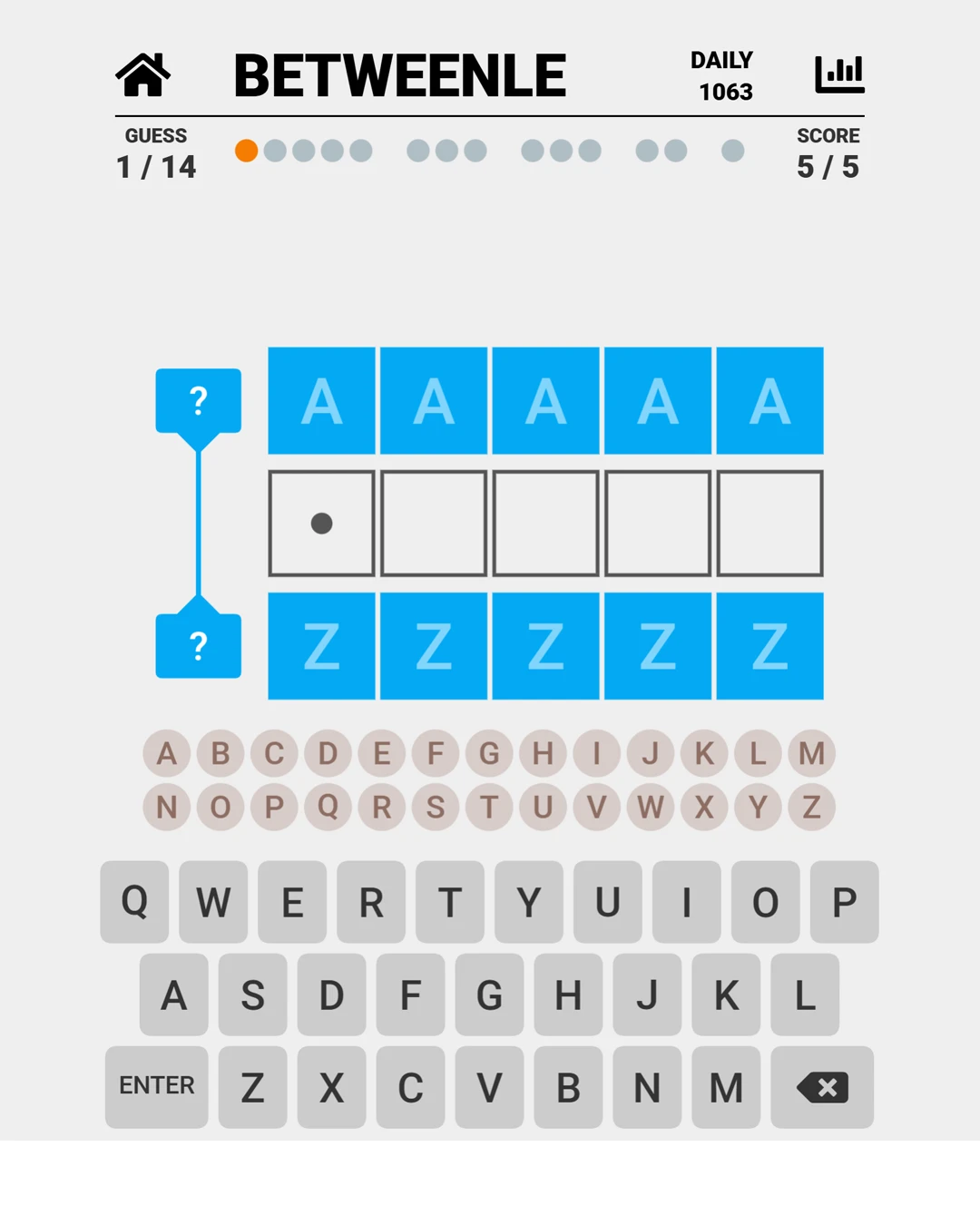
Betweenle is a daily word game about locating a hidden five-letter word inside an alphabetically sorted dictionary. Your guess becomes a boundary: the secret word lies before or after it. The game then shows a smaller valid interval for the next attempt. Unlike a spelling-feedback puzzle, it does not tell you which letters are present or in the right position. The puzzle is about position in a word list rather than shared letter patterns.
That difference makes familiar Wordle habits unreliable. A guess with many common letters may be useful in a letter-matching game but poorly placed in Betweenle’s dictionary. Here you want a word that cuts the remaining interval into useful parts. The best candidate is not necessarily a likely answer; it is often a valid word that helps you learn which half of the search space can be discarded.
Start with any accepted five-letter word. The game moves it to the upper or lower boundary according to whether the secret word comes before or after it in alphabetical order. Your next valid entry must fall inside the new interval. Repeat this process until the interval closes around the hidden word. The official instructions also show a position indicator that helps you judge whether the answer is nearer the top or bottom boundary.
Read the feedback as a statement about ordering, not similarity. A secret word can share no letters with your guess and still be alphabetically nearby. Conversely, two words that look almost identical can sit farther apart if many valid entries occur between them. Pay attention to the accepted dictionary rather than assuming every possible letter combination will be recognized as a word.
Once you have two boundaries, aim for a plausible word near the middle of the remaining list. A perfect midpoint is difficult to know without the game’s dictionary, but you can approximate it by changing the first letter, then the second, while considering common word groups. If the answer lies between two words beginning with different letters, the first letter carries most of the information. When both boundaries share a prefix, later letters become more important.
Avoid tiny movements unless the interval is already narrow. Guessing a word almost next to your lower boundary may confirm very little if the answer remains near the top. A broader middle guess usually eliminates more possibilities. If the game’s indicator suggests that the answer is strongly skewed toward one side, adjust that midpoint estimate rather than mechanically choosing the visual center of the alphabet.
The official tutorial shows an orange marker and a percentage-like distance cue relative to the word list. Treat that as a guide to where the secret word sits within the remaining dictionary interval. It is not a count of letter differences and it does not imply the target is a synonym of a boundary word. Its value is helping you choose the next region of the list to probe.
Because dictionaries are uneven, alphabetical space and word-count space are not the same. There may be many common words under one prefix and few under another. That is why a word halfway between two spellings can be a poor dividing guess. If you repeatedly land on the same side, reconsider your mental estimate of word density rather than assuming the feedback is inconsistent.
Follow the official Betweenle link above for the current daily word and its live instructions. The publisher also advertises a custom-word challenge and an unlimited mode in its app, but availability can differ between browser and mobile versions. CasualAtlas does not host the dictionary or provide a solver for the daily answer; this page is a guide to the search method.
Contexto is a contrasting word game: it ranks guesses by meaning rather than alphabetic position. Playing both makes the distinction clear. Betweenle favors ordered search through a fixed word list; Contexto favors exploring semantic neighborhoods. If you want a visual deduction break instead, Colorfle asks you to refine a color mixture with feedback after each attempt.
No. Guesses narrow an alphabetical interval rather than reveal matching letters.
The official tutorial currently asks for valid five-letter guesses.
No. The game accepts words from its dictionary.
The guess becomes a boundary, showing whether the answer falls before or after it.
Yes. The official instructions say later guesses must fit inside the current interval.
No. It indicates position within the dictionary interval.
Choose a valid word that divides the remaining range rather than one adjacent to a boundary.
The publisher currently advertises unlimited play in its mobile app; check the official site for browser options.
Both are word searches, but Contexto uses meaning while Betweenle uses alphabetical order.
No. It links to the official game and explains the solving approach.
Rules and live game: official Betweenle website . CasualAtlas is an independent guide and is not affiliated with the publisher.