Publisher preview shown for identification. Game names and publisher artwork belong to their respective owners.
Magnitudle · How big is it really? Resize a silhouette to find out.Official website
THE SHORT VERSION
Magnitudle at a glance
Magnitudle is a free collection of estimation games. Its Size It Up daily challenge puts a red target silhouette beside a blue reference of known size. Resize the target, lock in your estimate, and see how close your sense of scale was across five rounds. The publisher also offers a one-guess Daily Question and other modes.
Magnitudle quick reference
Goal
Estimate the real size of a target silhouette beside a known reference over five daily rounds.
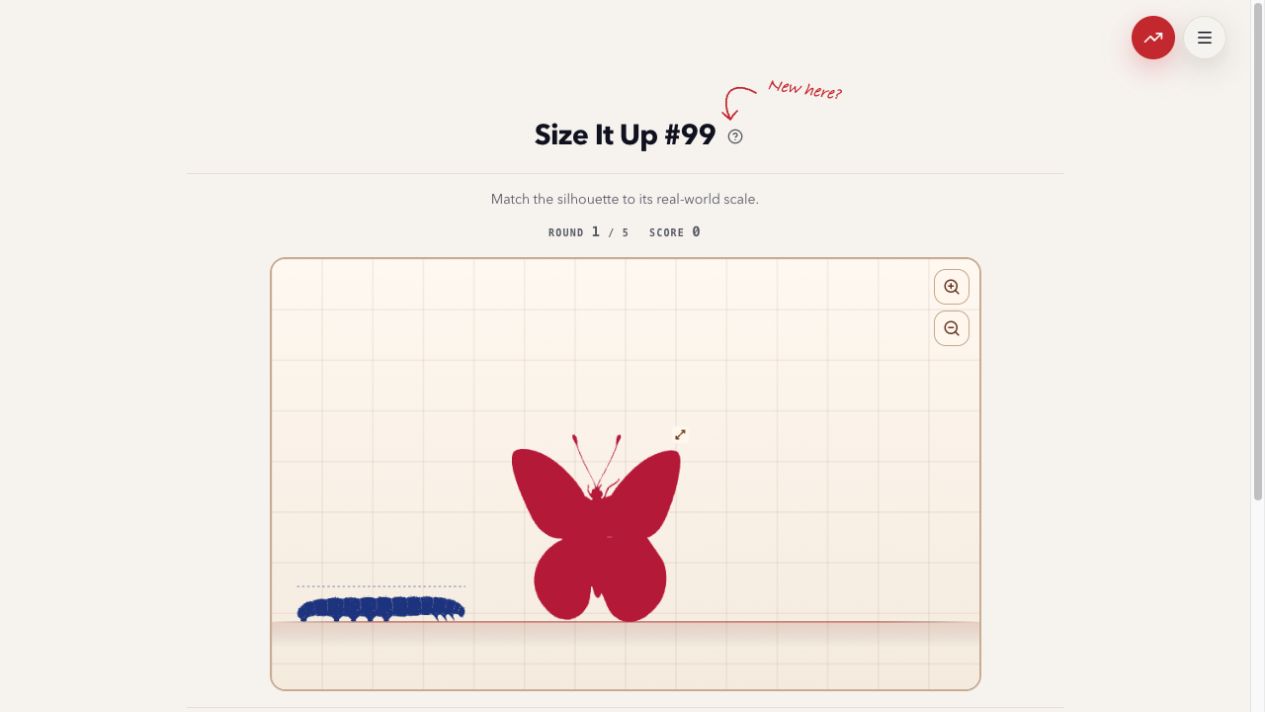
Seeing a butterfly beside a caterpillar makes an ordinary fact feel like a guess you actually have to commit to. The reveal is a tiny lesson in scale, even when you miss.
Place a fleet, search the grid, and sink every ship.
EDITOR'S TAKE
The rules are already in your hands, so you can get straight to the satisfying part: reading the grid and making a good call.
5–10 min
Easy start
Magnitudle asks a wonderfully simple question: how large is one thing beside another? Its original Size It Up game is a daily visual estimate, not a word puzzle or a test of exact measurements. This guide covers the five-round format, what the score means, and which of the publisher’s other modes to choose when you would rather guess a number than resize a shape.
Start Magnitudle in three steps
Open the original Size It Up game and compare the red target with the blue reference.
Resize the target silhouette until its relative scale looks plausible, then lock in the guess.
Read the true scale and score before moving to the next of five comparisons.
The official home describes visual resizing, five rounds, up to 100 points per round and the publisher. The live Size It Up board was checked directly.
What is Magnitudle?
Magnitudle is an independent collection of estimation games made by Teej and published through GriddleLink Games. The original visual game is Size It Up. You see two silhouettes: a blue reference whose real-world size is given and a red target you can resize. Your job is to make the target look right in relation to the reference before you lock in the estimate. The result shows the true scale and awards points for closeness. You do not need specialist facts to start, only a willingness to make an imperfect guess.
That visual setup makes scale feel less abstract. It is easy to know that a butterfly and a caterpillar have different sizes; it is harder to place them next to one another at the correct ratio. Magnitudle makes you commit to that ratio, then shows where your mental picture drifted. The game is about calibration rather than memorizing a fact sheet, which is why a surprising miss can be as interesting as a near-perfect round.
How to play the daily Size It Up game
Open the official Size It Up page and read the names of the reference and target objects. Study the blue reference first: its stated length or height is your anchor. Then resize the red target silhouette until the comparison looks plausible. Lock In commits that estimate and reveals the real scale. Continue through the daily set of five comparisons. The publisher says each round is worth up to 100 points, so a complete five-round game can total 500.
Try not to treat the first image as a speed test. Look at the unit and at what is being measured. A length comparison is not the same as an area comparison, and the outline may contain empty space that makes an object feel larger than its stated dimension. If the two silhouettes look nearly equal, ask whether the target should be half as long, twice as long, or only a little different. A rough ratio is usually more useful than a vague impression of big and small.
What does the score tell you?
The daily score reflects the distance between your submitted size and the actual size. A closer visual estimate earns more points, up to 100 in each round. On the official homepage, Magnitudle says an estimate within six percent of the target receives the full 100. That is a generous way to reward good intuition without demanding a perfect match on a drag control. Read the score together with the revealed dimensions rather than treating the number as the whole lesson.
After a miss, notice the direction of the error. Did you consistently make animals too large, underestimate a familiar household object, or confuse a long thin silhouette with a bulky one? A quick mental note before the next round is more useful than trying to remember the exact answer forever. The five comparisons are varied enough that the same kind of bias can show up in several forms, and the reveal gives you immediate feedback.
Size It Up, Daily Question, and the other modes
The name Magnitudle now covers more than one daily game. Size It Up is the visual silhouette challenge, with standard, Pop Culture and Geography variations linked from the publisher’s homepage. Daily Question takes a different route: it asks for one numerical estimate to a real-world question. Weigh It Up shifts the focus to weight, while Weekly 1K and Survival offer different pacing. The Archive lets you revisit published puzzles rather than waiting for tomorrow’s new comparison.
Choose by the kind of uncertainty you enjoy. If you like comparing two visible shapes, start with Size It Up. If a number such as a population, distance or quantity is the part you want to reason toward, open Daily Question instead. Do not assume that a tip for one mode transfers perfectly to another: resizing a silhouette uses spatial intuition, while estimating a numeric quantity may call for a remembered anchor and a little arithmetic. The official menu is the best place to check today’s current selection.
A better first guess, without turning it into homework
Pick one reliable anchor before moving the target. For a living thing, that may be the length of a hand, a door, or another creature you have seen at close range. For a landmark or a map shape, think in familiar multiples rather than exact numbers. Set a rough ratio, look at the silhouettes again, and adjust once. This keeps the game quick while making the guess more deliberate. Spending five minutes researching the answer would remove the small thrill of finding out how good your intuition already was.
Magnitudle works especially well as a short daily reset because it gives a clear answer after each commitment. You can play the original for free in a browser, and CasualAtlas sends you there rather than hosting a copy. The publisher controls the live puzzles, scores and future modes. This independent guide describes what we checked on the official site; the screenshot above is a preview of its visual board, not a playable game embedded here.
Magnitudle questions, answered
01What is Magnitudle?+
A free collection of estimation games from Teej / GriddleLink Games, led by the visual Size It Up daily game.
02What do you do in Size It Up?+
Resize a target silhouette beside a reference of known size, lock in the estimate, and see the actual scale.
03How many rounds are in the daily game?+
The standard Size It Up daily game has five comparisons.
04What is the maximum Size It Up score?+
Each round can earn up to 100 points, for a total of 500.
05How close is a full-score estimate?+
The publisher says an estimate within six percent of the target earns 100 points.
06Is Daily Question the same as Size It Up?+
No. Daily Question asks for one numerical estimate; Size It Up asks you to resize a visual silhouette.
07Are there other Size It Up themes?+
Yes. The official homepage links standard, Pop Culture and Geography variations.
08Can I play previous Magnitudle puzzles?+
The publisher offers an Archive for past published puzzles.
09Who makes Magnitudle?+
The official site credits Teej and GriddleLink Games.
10Is CasualAtlas affiliated with Magnitudle?+
No. This is an independent guide linking to the original game on magnitudle.com.
Rules and live game: official Magnitudle website . CasualAtlas is an independent guide and is not affiliated with the publisher.