
Daily · Original
PokeDoku Strategy and Uniqueness Score
Nine squares. A world of Pokemon knowledge.
EDITOR'S TAKE
The grid gives Pokemon fans a reason to reach for something more interesting than the first obvious answer.
Pokémon deduction · Video game

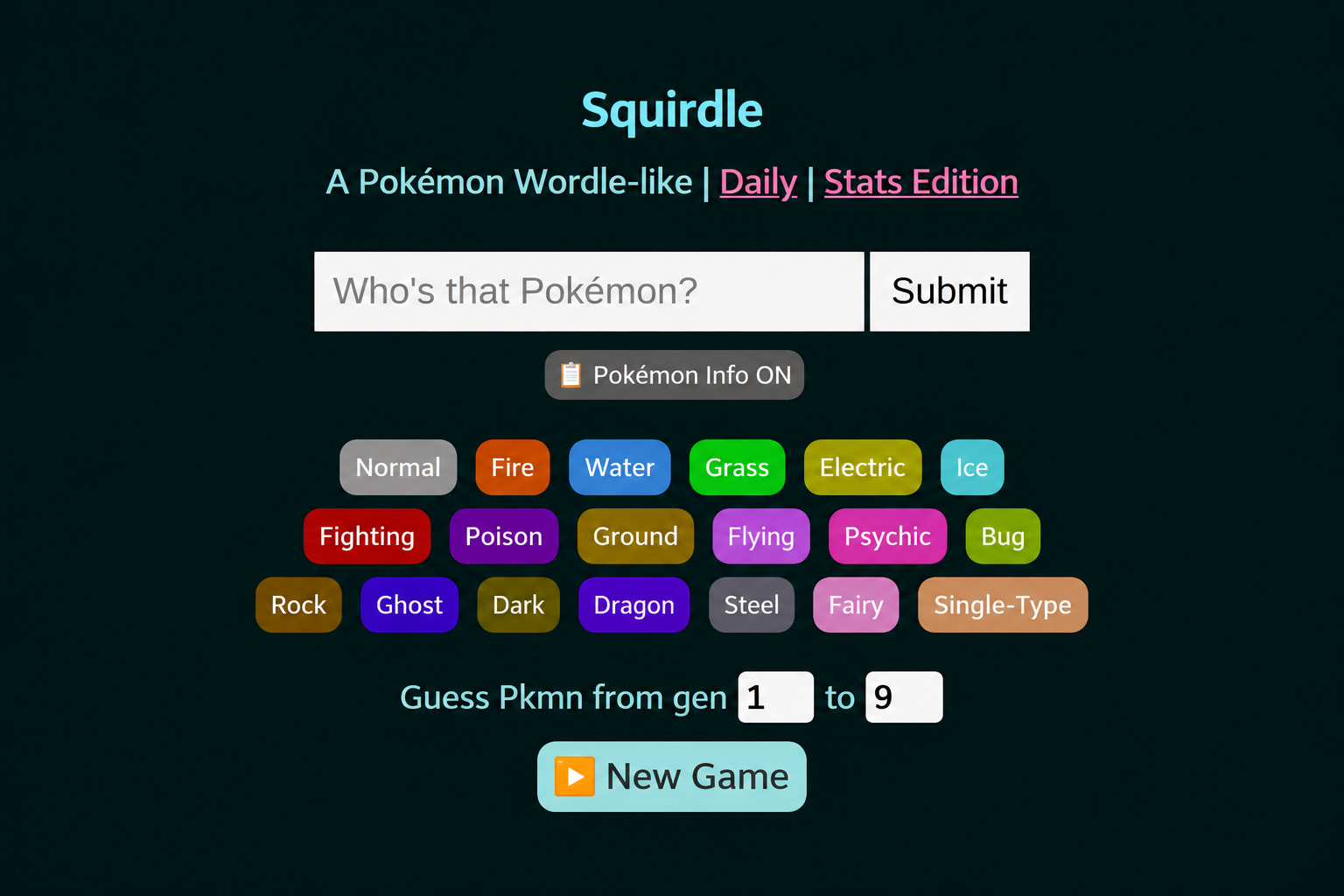 Squirdle
THE ORIGINAL DAILY GAME
Guess a Pokémon from types, generation, height and weight. The original game opens on its publisher’s website in a new tab.
THE SHORT VERSION
Squirdle turns the familiar daily guessing format into a Pokémon deduction puzzle. Instead of letter positions, each guess gives feedback for generation, primary and secondary type, height, and weight. Its official site also offers repeatable Free Play and a separate Stats Edition.
| Goal | Identify the hidden Pokémon from five attribute clues. |
|---|---|
| Category | Video game trivia |
| Clue columns | Gen, Type 1, Type 2, Height, Weight |
| Up arrow | Your guess was too low |
| Down arrow | Your guess was too high |
| Where to play | Squirdle on the publisher’s website |
WHY WE PUT IT ON THE SHELF
A nice test of the Pokédex in your head: type gives you a foothold, and those height and weight arrows do the finer detective work.
Nine squares. A world of Pokemon knowledge.
The grid gives Pokemon fans a reason to reach for something more interesting than the first obvious answer.

Spot the game behind the screenshot.
It is a good excuse to trust your eye for menus, camera angles, and old graphics before the answer becomes obvious.
Identify League of Legends champions from five kinds of clues.
Five different clue styles keep it from becoming one more champion-name quiz. It rewards the kind of knowledge League fans actually carry around.

Guess a One Piece character in four daily modes.
The spoiler setting is the quiet hero here: it lets you test what you remember about the cast without the game blurting out a bounty from an arc you have not reached.

Four puzzles. Twelve orbs. Six to win.
Four small puzzle moods in one place means you can skip the one that is not clicking and still have a good break.

Two plates. Which one gets your vote?
It turns questionable stadium food into a surprisingly good argument. The round is quick; comparing your pick afterward is the fun part.
Squirdle asks you to identify a hidden Pokémon, but its feedback has nothing to do with letter positions. Each guess is compared across generation, primary type, secondary type, height, and weight. This independent guide explains the five columns, the easy-to-reverse arrows, and the differences between the publisher’s Daily, Free Play, and Stats Edition pages.
“🔼: Guessed too low”
The official page lists all five clue columns and links to Free Play and Stats Edition. Stats Edition is a separate stat-based puzzle, not merely a record of Daily results.
Open Squirdle Daily and enter a Pokémon name. The game checks attributes of that Pokémon against the hidden one. The five headings are Gen, Type 1, Type 2, Height, and Weight. Instead of telling you which letters are in the answer, it tells you whether the creature you named shares a generation or type and whether its physical measurements are above or below the target. This makes a little Pokédex knowledge more useful than spelling tricks.
The name input suggests Pokémon while you type, which helps when you know a creature but are not certain how its name is entered. Read the whole feedback row after each submission rather than grabbing a single green marker and rushing to another favorite. A guess can be wrong overall and still eliminate a large part of the possible field. The useful question is not “Which Pokémon do I like?” but “Which candidate will test my current theory?”
For a One Piece character challenge with four clue modes, see our Onepiecedle guide.
The publisher’s Daily page labels green as a correct attribute, red as an incorrect one, and yellow as a type that is present but in the other type position. The two arrows are especially easy to misread: the up arrow means your guessed value was too low, so the answer is higher; the down arrow means your guess was too high, so the answer is lower. Those size clues apply to height and weight, and generation can also be compared as an ordered value.
Type 1 and Type 2 are categorical rather than numerical. Yellow does not mean “almost the same type”; it means the type appears in the other slot. If a candidate has the right type in the wrong position, keep that information while changing the combination. A red type result rules out that match for the compared column, while green confirms one part of the target. Taken together, the five fields give more information than the red and green squares alone suggest.
Begin with a Pokémon whose generation and types you know and whose size is not an extreme outlier. A familiar first guess gives you a row you can actually interpret. Next, use the generation clue to narrow the era, then use type feedback to filter candidates. Height and weight arrows are best treated as boundaries: the target lies above or below the measurements of a particular guess. Record those boundaries mentally before picking a second creature.
A later guess should test multiple unresolved fields. If you already have a correct primary type, avoid a candidate that discards it without a reason; use the remaining type slot or a more informative size to learn something new. If height says up and weight says down, look for Pokémon that are taller but lighter than your last guess. That combination can be far more distinctive than either arrow by itself. It is an inference method, not a fixed official solving order.
The official Squirdle Daily page links to Free Play and Stats Edition. Daily is the shared daily puzzle. Free Play lets you start another game, with controls such as generation-range filters. It is the clearest official route when you want to practice the five-attribute version again without waiting for the next daily round. The publisher’s pages can change, so use their navigation for the current modes rather than a look-alike host.
Stats Edition is not merely a scoreboard for your Daily streak. It is another playable variant with six columns: HP, Atk, Def, Sp.Atk, Sp.Def, and Speed. Its documented filter keywords are hp, atk, def, spa, spd, and speed. The page has a New Game button, making it repeatable, and its default emoji key only needs three signals: green for correct, up for a guess that was too low, and down for one that was too high. Unlike Daily’s type columns, its six stat columns have no yellow wrong-position type marker in that key. The publisher calls Stats Edition a work in progress, so check the live page if its rules change.
The Daily page provides Pokémon-name selectors for English, Korean, Japanese, French, and German. Those are name-entry options, not a promise that every line of the interface has been translated into each language. If a familiar creature does not appear under the spelling you expect, check the selected name language before assuming it is missing from the game. The official site also has an advanced filters guide for players who want tighter control.
Squirdle sits naturally next to PokeDoku in CasualAtlas. PokeDoku asks you to fill intersections in a Pokémon trivia grid; Squirdle asks you to identify one hidden Pokémon from comparative attribute feedback. LoLdle is another game-universe guessing option, but it draws on League of Legends rather than Pokémon. Use the related links for those guides and the official publisher button for Squirdle itself. CasualAtlas does not run the puzzle or claim an affiliation with its creator.
Identify a hidden Pokémon using attribute feedback from your guesses.
Generation, Type 1, Type 2, Height, and Weight.
The compared attribute is correct.
That type is present in the other type position.
Your guess was too low; the target value is higher.
Your guess was too high; the target value is lower.
Yes. The official site links to repeatable Free Play.
No. Stats Edition is a separate playable variant based on Pokémon combat stats.
The official Daily page offers English, Korean, Japanese, French, and German name options.
No. Squirdle asks you to identify one hidden Pokémon; PokeDoku asks you to fill a category grid.
Rules and live game: official Squirdle website . CasualAtlas is an independent guide and is not affiliated with the publisher.