
Champion quiz · Gaming game
LoLdle
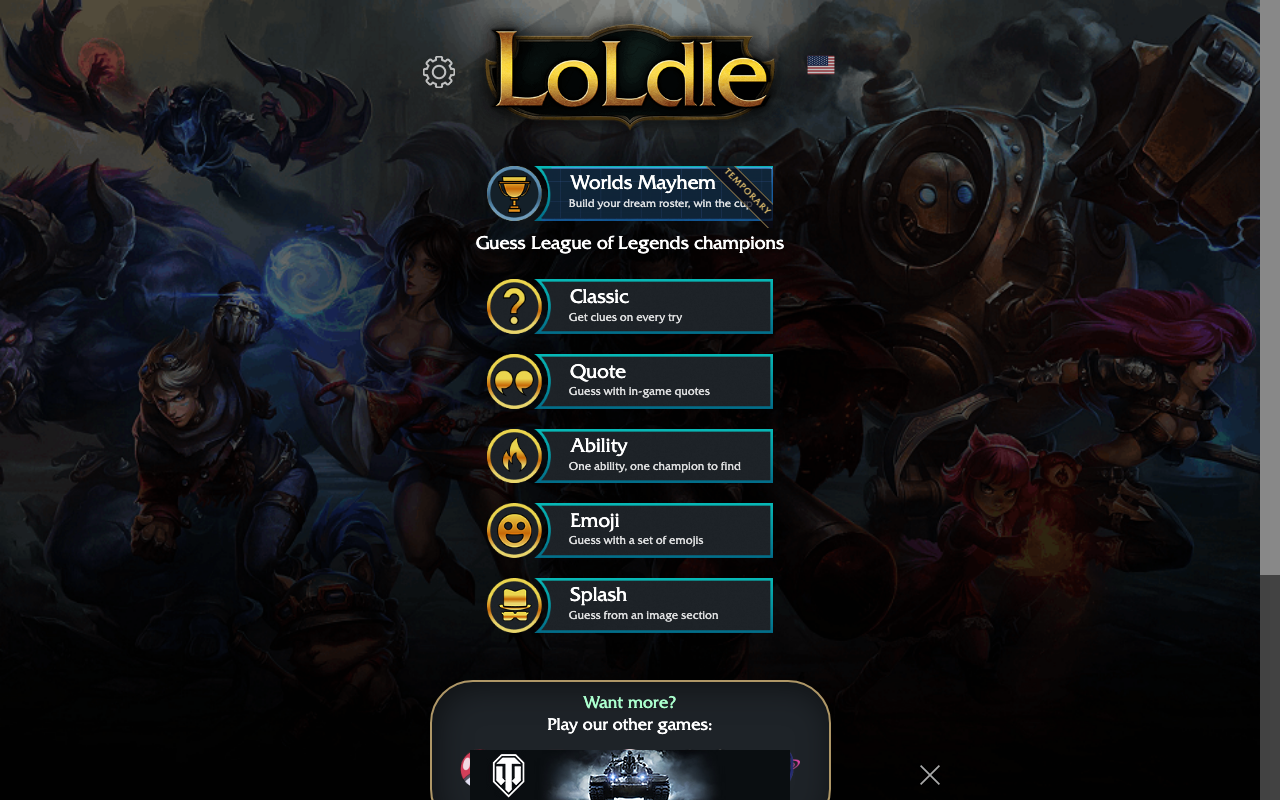
THE ORIGINAL DAILY GAME
Ready for today’s LoLdle?
Identify League of Legends champions from five kinds of clues. The original game opens on its publisher’s website in a new tab.
THE SHORT VERSION
LoLdle at a glance
LoLdle is a daily League of Legends fan quiz with Classic, Quote, Ability, Emoji, and Splash challenges. It tests champion knowledge from different angles: comparison clues, dialogue, an ability image, emoji hints, and a cropped splash illustration.
Related games
Explore Gaming



LoLdle is a League of Legends champion guessing game with five daily clue formats. It is easier to enjoy when you know which kind of evidence each mode provides and avoid treating a vague quote or cropped image as a guaranteed identification.
What is LoLdle?
LoLdle turns knowledge of League of Legends champions into five distinct daily puzzles. Classic compares your guesses against hidden champion attributes. Quote asks you to identify a speaker from in-game dialogue. Ability uses an ability image. Emoji offers a small set of pictorial hints, and Splash shows part of a champion illustration. The same player can be excellent at one mode and struggle with another because each calls on a different memory.
The publisher's home screen presents the modes separately rather than as one long test. You can choose the clue type you find most interesting, or use all five as a short daily routine. CasualAtlas is not the game publisher and is not affiliated with Riot Games. This page identifies the fan game and explains practical ways to reason from its visible clues without copying the daily answers.
Start with Classic mode
Classic is the most systematic starting point because each guess returns several comparisons. Instead of naming a favorite champion at random, choose a candidate that tells you something useful about broad attributes. Read the row of feedback before guessing again. A useful guess rules out groups of champions or tightens a date-related range, while a guess made solely because the name is familiar may repeat information you already have.
Maintain a short list of candidates that fit every confirmed clue. When the list is still large, prefer a guess that divides it meaningfully. If the feedback suggests a particular role or region, do not ignore it because another character feels visually similar. The exact attribute set and visual feedback belong to the live game, so read the current interface carefully rather than relying on an old screenshot of a previous round.
Quote and Ability: context before recognition
A quote can sound generic when read out of context. Look for references to a place, relationship, title, weapon, or personality before attaching it to a champion. Some lines are spoken in a stylized voice that is easy to remember, while others share ordinary fantasy vocabulary. If you have a candidate, ask what in the sentence actually supports the choice instead of treating one familiar word as proof.
Ability clues reward a different kind of attention. Inspect the image's color, silhouette, symbol, and apparent effect. A flame, blade, projectile, or movement motif can suggest a champion class, but many ability icons use similar visual language. Try to identify a unique detail and compare it with the abilities you know, not just the champion splash art. The mode is about recognizing one skill, not necessarily the character's most famous appearance.
Emoji and Splash: read the clue as a combination
In Emoji mode, one symbol can be misleading. Read the set as a cluster of hints about a champion's theme, story, weapon, role, or visual design. Several champions may fit a sword or crown in isolation; far fewer fit the entire combination. Write down two or three candidates and test each against every emoji. A candidate that explains only one clue is usually weaker than one that makes sense of the whole sequence.
For Splash, focus on features that survive the crop. Armor shape, hair, weapons, color treatment, background setting, and costume details can be more useful than a vague impression of the illustration. Remember that skins can change the look dramatically. Compare the visible evidence with known champion or skin art and stay ready to revise. Guessing from overall color alone is particularly risky when multiple champions share a palette.
Make a short daily routine useful
Pick a mode before you look up any related art or champion roster. If you want to learn rather than simply finish, note what the first clue made you think and which later clue changed your mind. This helps separate memory of game mechanics from memory of marketing illustrations. Across several days, you may discover that you know quotes well but confuse ability icons, or that Classic comparisons are more reliable than your visual intuition.
Avoid sharing an answer before friends have played. A short spoiler can remove the entire point of a daily recognition game, especially for Quote or Splash. You can still discuss strategy without revealing the champion: describe which kinds of clues were decisive and whether a false lead was common. If you want another video-game identification challenge afterward, GuessThe.Game uses screenshots rather than champion attributes.
Where to play and what this guide covers
The Play LoLdle button opens loldle.net, the publisher's site. Its current interface, supported modes, and daily clues are the source of truth. CasualAtlas only provides a directory entry, a local preview image for identification, and this independent explanation. It does not host the puzzle, mirror champion assets for play, or claim an official relationship with the League of Legends franchise.
If five modes feel like too much, play only the format that matches your interests. Classic suits deduction, Quote suits voice-line memory, Ability suits mechanical knowledge, Emoji suits interpretation, and Splash suits visual recognition. PokeDoku is a related but separate grid challenge for Pokémon knowledge. The connection is not the license or the rules, but the pleasure of using a game world you already know as puzzle material.
LoLdle questions, answered
01What is LoLdle?
A daily League of Legends fan game about identifying champions through several clue formats.
02How many LoLdle modes are there?
The publisher currently lists Classic, Quote, Ability, Emoji, and Splash.
03What does Classic mode show?
It compares champion attributes after each guess to help narrow the hidden answer.
04What is the Quote puzzle?
It asks you to identify the champion associated with an in-game line.
05What does Ability mode use?
An ability image is the clue to a champion identity.
06How should I read Emoji clues?
Interpret the set together; one symbol alone often fits too many champions.
07Can a skin make Splash mode harder?
Yes. Skins can change colors and costume details, so inspect specific visual features.
08Is CasualAtlas affiliated with Riot Games or LoLdle?
No. This is an independent directory and guide linking to the publisher.
09Does this page contain today's LoLdle answers?
No. It explains the formats without publishing daily solutions.
10Where can I play the live game?
Use the Play LoLdle link above to open loldle.net.
Rules and live game: official LoLdle website . CasualAtlas is an independent guide and is not affiliated with the publisher.